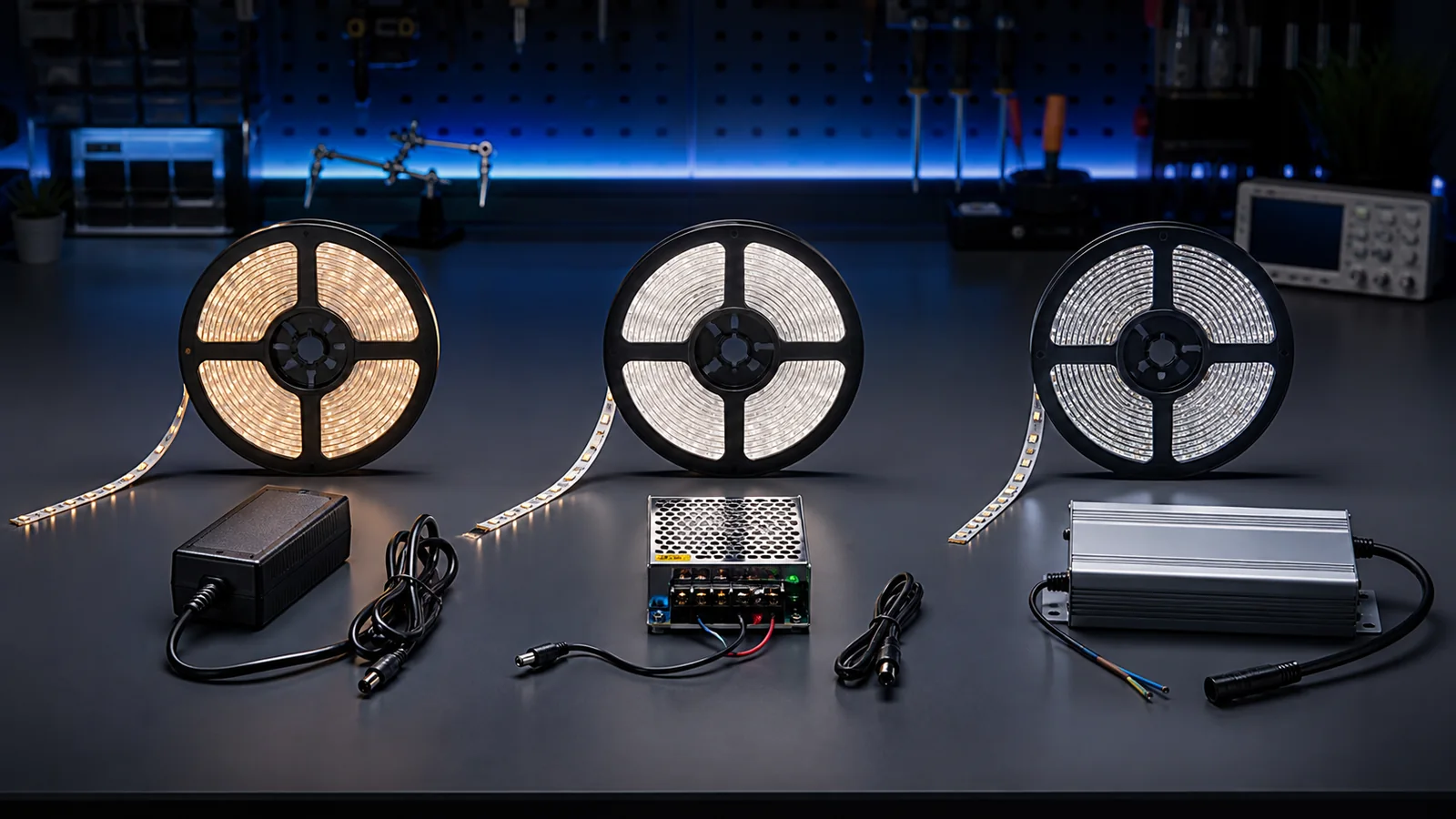
The correct LED strip voltage is not simply the highest or lowest number. For a B2B project, the right choice depends on run length, cut length, voltage drop, electrical regulations, installation access, control method, and the experience of the installer.
As a practical starting point, 12V is useful for short sections and compact systems, 24V is the common choice for commercial low-voltage projects, and 220V can simplify long decorative runs where a compliant high-voltage system is appropriate. The final product, driver or rectifier, connector, cable, and protection method must be selected as one system.
Quick Comparison
| Factor | 12V DC | 24V DC | 220V AC system |
|---|---|---|---|
| Typical use | Vehicles, signs, cabinets, short modules | Hotels, retail, coves, furniture, commercial interiors | Long outlines, seasonal decoration, facade accents |
| Voltage drop | More noticeable on long runs | Lower current than 12V at equal power | Supports longer supplied lengths, model dependent |
| Cutting flexibility | Often short cut increments | Varies by PCB and LED layout | Usually longer cut increments |
| Power equipment | Compatible 12V driver | Compatible 24V driver | Compatible rectifier/plug and accessories |
| Installation | Extra-low-voltage design | Extra-low-voltage design | Must follow local mains-voltage rules |
| Controls | Wide dimming/controller choice | Wide dimming/controller choice | Requires model-compatible controls |
The reel length printed on a quotation is not automatically the maximum single-end powered run. Ask for the maximum recommended powered length, feed arrangement, conductor size, and voltage-drop limit for the exact model.
When to Choose 12V
Choose 12V when the project uses short sections, needs compatibility with an existing 12V system, or requires a model with a short cutting unit. Common examples include vehicle interiors, display cases, small signs, and compact furniture lighting.
At the same wattage, a 12V strip draws twice the current of a 24V strip. More current means cable size, connector rating, and voltage drop deserve closer attention. A long 12V run may need power injection from both ends or at intermediate points.
For wholesale orders, confirm:
- watts per meter and actual tolerance;
- PCB width and copper specification;
- cut length and solder-pad layout;
- maximum recommended feed length;
- driver and controller compatibility;
- whether the quoted waterproof process changes the cut or connection method.
When to Choose 24V
For many commercial interiors, 24V provides a useful balance of safety, control compatibility, available models, and manageable voltage drop. It is frequently specified for hotel coves, retail shelving, linear profiles, wardrobes, and architectural details.
However, 24V does not remove the need for electrical planning. Long continuous lines still require voltage-drop calculations and appropriate feed points. High-output strips also need thermal management. An aluminum profile can improve mounting consistency and heat transfer, but its dimensions and ventilation still matter.
Buyers should compare samples using the same color temperature, power, diffuser, and camera settings. Otherwise a brighter photograph can make a lower-consistency product look better than it performs in the project.
Explore current low-voltage LED strip models and request the data for the exact SKU you intend to buy.
When to Choose 220V
High-voltage LED strip systems can be attractive for long decorative outlines because they reduce the number of remote drivers and feed points. They are often considered for building outlines, holiday displays, and long commercial features.
This convenience comes with different responsibilities. A 220V strip is a mains-voltage product. It requires compatible rectifiers, plugs, end caps, connectors, insulation, mounting methods, and qualified installation according to destination-market rules. It should not be treated like a low-voltage tape simply because the light source is flexible.
Before ordering, ask the supplier to state:
- rated voltage and frequency;
- cut increment and maximum recommended powered length;
- included and optional accessories;
- waterproof rating of both the strip and completed connections;
- dimming or control compatibility;
- model-matched specification and acceptance records;
- packing length per reel and carton data.
View the high-voltage LED strip category for currently listed families.
Questions for Your Supplier
A useful RFQ should include more than “best price for LED strip.” Send the application, voltage, color temperature, watts per meter, LED density, PCB width, IP requirement, roll length, total quantity, destination country, packaging, and required documents.
Ask the supplier to return a model code and specification sheet with the quotation. Then approve a physical sample and keep it as the reference for mass production. For repeat orders, reconfirm any changes in LEDs, PCB, adhesive, silicone, cable, connectors, or packaging.
A low unit price is valuable only when the delivered specification, installation cost, and failure risk remain under control.
FAQ
Is 24V always better than 12V?
No. 24V generally reduces current and voltage drop at the same power, but 12V may offer a shorter cut unit or match an existing system. Choose by application and model data.
Can a 220V LED strip connect directly to mains power?
Only as part of its designed system, using compatible rectifier/plug, connectors, sealing, protection, and installation practices. Follow local electrical rules and use a qualified installer.
What information is required for an accurate quotation?
Provide voltage, watts per meter, color temperature or RGB type, IP rating, roll length, quantity, destination, packaging, accessories, and required documents. If a value is undecided, describe the application and installation dimensions.
Specifications vary by model. Confirm the formal quotation, sample, and model-matched documents before placing a bulk order.
Catalog & Sourcing Note
This article is prepared from our current product catalog and B2B specification workflow. Electrical, waterproofing and installation requirements vary by model and market, so confirm the final specification and approved sample before ordering.
Discuss Your Specification