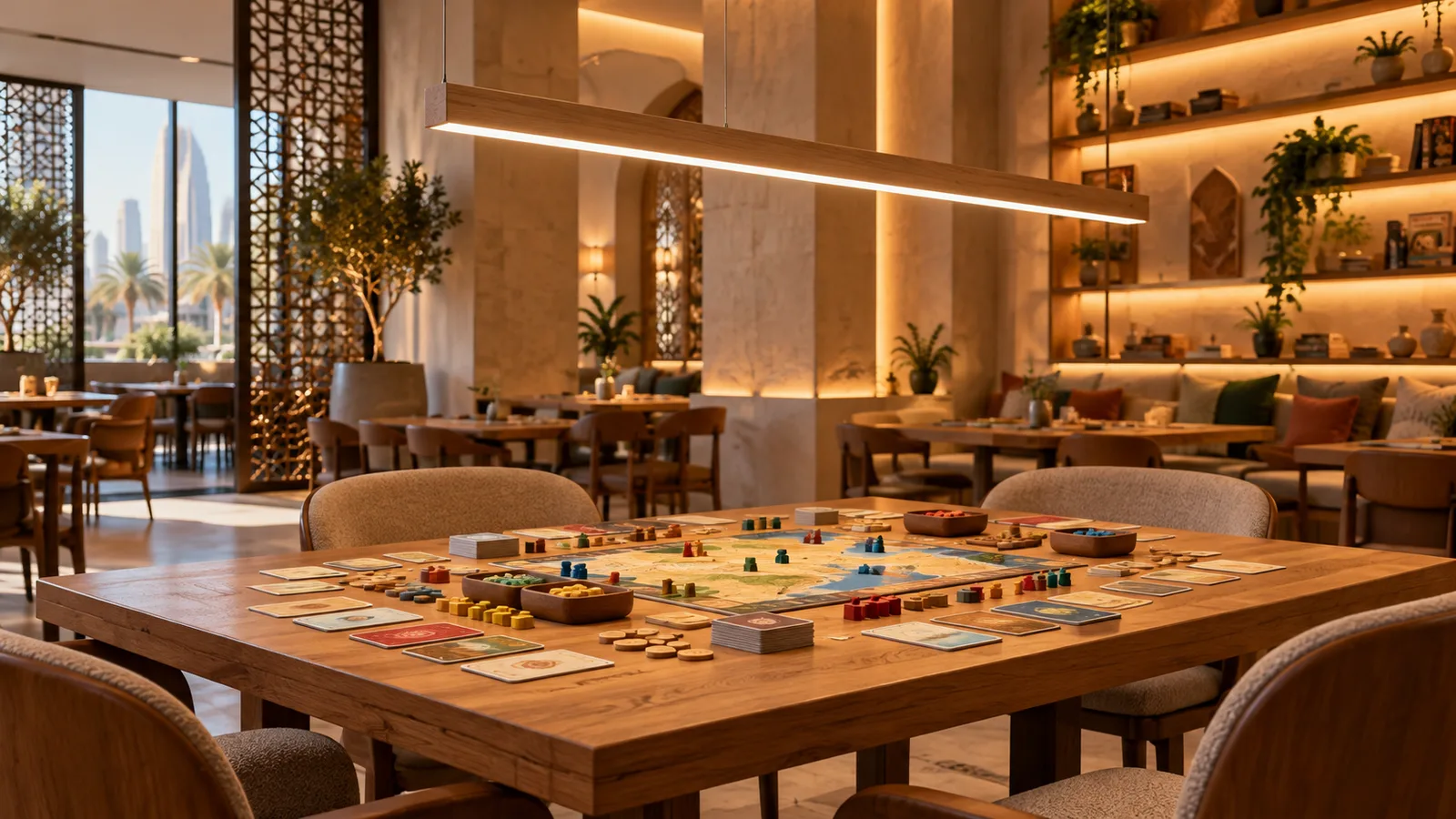
For a board game café, start with separately controlled white light over the playing surface and use concealed LED strips for background and shelf lighting. A strip-lit cove can make the room inviting while leaving small rules text difficult to read. Approve the occupied table with actual cards and pieces before repeating a layout across the venue.
These five layouts serve different tasks in UAE, Saudi and other GCC fit-outs. Compare print readability and glossy-card reflections from player sightlines, then check hand shadows and maintenance access. The full lighting scheme still needs project-specific design, including any required emergency lighting. A decorative strip detail cannot cover that scope.
Use the games and furniture in the lighting brief
List the table sizes and seating positions, whether tables move, and the materials players handle. A café used for large boards, miniatures and laminated cards needs a different sample from a lounge used mainly for conversation. Identify the playing scene, cleaning scene and any event scene before choosing the controls.
ERCO’s guidance on brilliance and glare distinguishes concealed sources, indirect room light and directed table light. Its examples also show that reflective objects can reproduce the light source. Applied here, the design check is whether that reflection helps the room’s appearance or obscures the information on a card. The layouts below are project-planning choices, not tested ERCO or LEDStripStar café systems.
Compare the five details by what they illuminate
| Layout | Best fit | Limitation to check |
|---|---|---|
| Diffused linear assembly above the table | White task-light candidate for fixed game tables | Card reflections, direct glare and lighting uniformity |
| Concealed ceiling cove | Background light across the room | Does not establish enough light on the game |
| Concealed light behind banquette seating | Background separation near perimeter tables | Keep the source out of player sightlines |
| Game-library shelf lighting | Reading box titles and selecting games | Tall boxes can hide the light or leave shadows |
| Concealed counter or joinery accent | Reception identity and circulation cues | Decorative light cannot replace task or emergency lighting |
1. Diffused linear lighting above fixed game tables
Consider LED strip inside a purpose-designed linear lighting assembly, with the source concealed or diffused and the mounting checked by the fit-out team. Evaluate the entire fixture for thermal management, electrical suitability and useful light on the table. A bare tape fixed above the table is not an equivalent assembly.
The 8mm CRI95 COB family is a source candidate for sampling a selected white variant. Its CRI label does not predict table illuminance or glare. Check the actual diffuser and position using the diffusion guide, and assess reflections from every seat.
If moving the light to eliminate a reflection leaves part of the board dark, revise the complete fixture layout or use a suitable task luminaire. Ordering a brighter strip alone does not resolve that geometric conflict.
2. Concealed ceiling cove for background light
Use a cove where the room needs an indirect background layer. Test the ceiling finish and cove lip from seated positions, including players who lean back. A glossy finish can still show a source line.
An independent cove control lets staff adjust the room background while keeping the light needed to read a game. The 8mm CRI80 COB family is a candidate for this role, subject to the chosen variant and assembled sample. Its catalog power does not establish illumination for gameplay.
3. Concealed light behind perimeter seating
A shielded wall or seating detail can separate the banquette from the background without adding an exposed bright line at eye level. Include the actual upholstery and wall finish in the sample. Players seated opposite the detail may have a different view from someone standing beside it.
Protect this detail from cleaning and furniture movement while keeping joints and drivers accessible. It adds background light, so the playing surface needs a separate assessment.
4. Game-library shelf lighting
Place a concealed source where customers can read box titles, including the lower shelves. Test a fully loaded shelf with the tallest boxes and normal browsing positions. A lighting detail that works in an empty shelf may be obscured after stocking.
The 5mm CRI90 COB family is a narrow source candidate. Confirm the profile fit, clearance and selected white variant. Avoid running exposed wires through places where customers slide boxes in and out.
5. Counter and joinery accents away from the game surface
A concealed front-desk or joinery line can give the arrival area a recognizable lighting detail. Color effects belong here only if their spill does not interfere with game visibility or nearby white-light comparisons. Keep the playing scene separately controlled.
For color effects, compare the RGB and addressable range with the actual controller requirement. Confirm whether the intended effect is uniform color or pixel animation. Do not presume a dedicated white channel, a control protocol or a particular preset from a category name.
Test an occupied table before repeating the layout
Set up the actual table and chairs with the chosen lighting assembly. Put glossy cards at different orientations, small rules text near the corners and colored pieces across the board. Have users sit in every position and move their hands as they would during play.
Check whether a hand or head blocks another player’s view, whether a reflected line covers card text, and whether seated players see a bare source. Have the lighting designer define any required illuminance measurements and positions. Record the sample’s fixture positions, white CCT, controls and accepted operating scenes.
Color differentiation needs its own assessment. If red pieces or printed artwork drive selection, review the Ra and R9 guide; a high general CRI is not a guarantee for every game material. Do not use a phone photograph as numeric color evidence.
Repeat the check in the expected night scene, not only with daylight filling the café. Verify that staff can recall the agreed playing and cleaning scenes without opening a technical configuration menu.
Order the detail that passed the table test
Give each zone a reference, strip model and selected variant, installed length, profile and diffuser detail, driver location, control interface and scene requirement. Include table positions and the decision about moving furniture. Use the driver-access guide before closing joinery or ceilings.
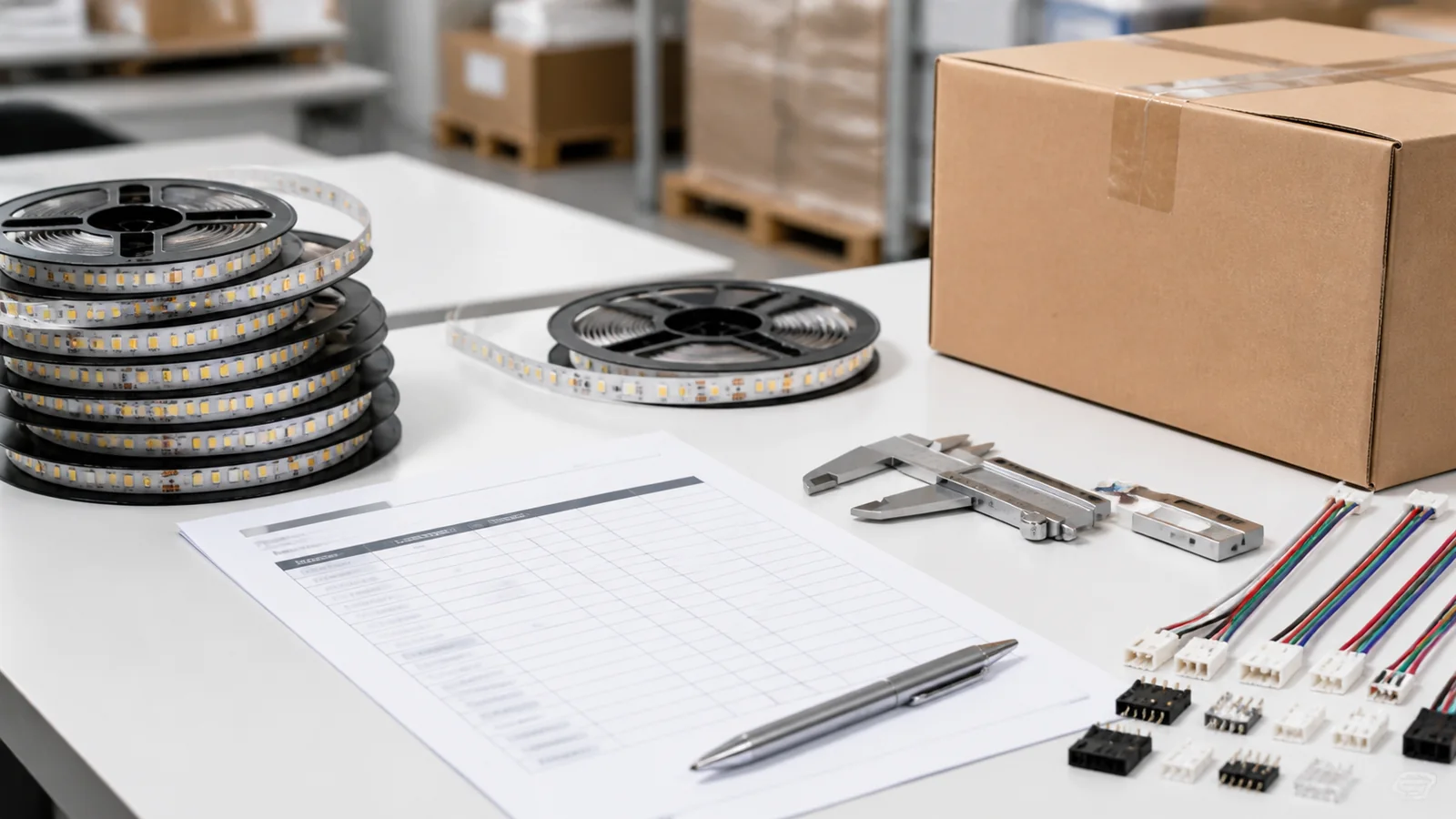
LEDStripStar’s standard MOQ is 500 meters and custom MOQ is 2,000 meters. Consolidate matching specifications across the fit-out only after the sample is accepted. Send the zone schedule through the quotation form, with destination-market requirements confirmed by the importer and project team before ordering.
Catalog & Sourcing Note
This article is prepared from our current product catalog and B2B specification workflow. Electrical, waterproofing and installation requirements vary by model and market, so confirm the final specification and approved sample before ordering.
Discuss Your Specification