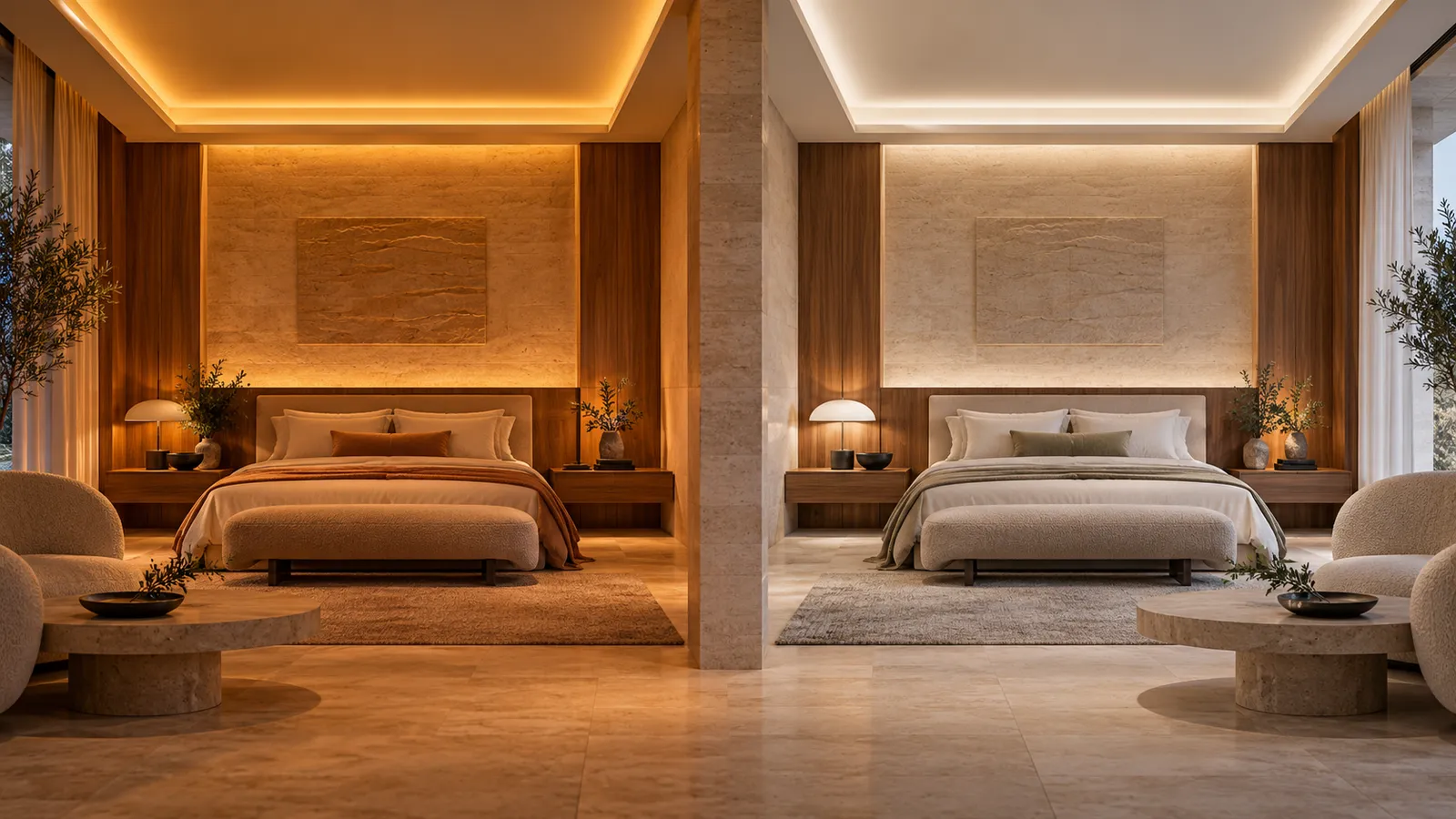
Choose dim-to-warm when reducing brightness should automatically make the light warmer. Choose tunable white when users need to adjust brightness and white tone separately. A fixed-white strip is suitable when the specified white tone should remain broadly unchanged while dimming. Ordinary dimming does not establish a dim-to-warm function.
For a hotel bedroom or restaurant cove, specify the behavior before choosing the strip. The phrase “warm dimmable COB” could mean fixed warm white, automatic warm dimming, or adjustable white tone. A quotation needs to say which one.
Choose the relationship between brightness and white tone
The U.S. Department of Energy’s color-tunable product explanation distinguishes automatic warmer color as light output falls from white tuning with separate intensity and color control. It also explains that mixing two white LED channels can deviate from the blackbody curve. An intermediate white setting therefore needs visual review, even when the endpoints look acceptable.
The finished system determines this behavior. A COB phosphor line, an LED count per meter or a “dimmable” label does not tell the buyer how brightness and white tone will interact.
| Requirement | Candidate behavior | Evidence to request | Limit to check |
|---|---|---|---|
| Dim a cove while keeping the selected white tone | Fixed white with compatible dimming | Sample through the intended brightness range | Small color shifts and low-end stability still need review |
| Make an evening scene warmer as it dims | Dim-to-warm system | Agreed brightness-to-color curve and working sample | Brightness and color are intentionally coupled |
| Keep a low-output scene neutral or cool | Tunable-white system | Separate brightness and color commands | Available output may change across color settings |
| Use both independent adjustment and an automatic evening scene | Tunable white with suitable programmed behavior | Controller configuration and demonstration of both modes | An automatic curve is not guaranteed by the tape alone |
Ask the operator how the room will be used. A restaurant may want a single control that dims and warms the cove together. A hotel guest may want dim neutral light for watching television and a warmer scene later. Similar-looking tape can serve either brief only with the appropriate controls.
For the fixed-temperature choices themselves, use the separate LED strip CCT guide. Selecting a warm endpoint does not define what happens between scenes.
Check the tape, driver and controller together
A tunable-white tape typically has warm and cool white channels. Confirm its pinout and supply voltage in the order specification, then match the controller’s channel arrangement and operating modes. A brightness-only output cannot provide independent white tuning.
Some controllers can map a single user command to a programmed combination of white channels. That can provide a warm-dimming scene if the tape covers the required tones and the controller supports the mapping. Have the integrator demonstrate the behavior with the actual tape. Do not assume that every CCT controller includes it.
For a proposed LEDStripStar assembly, the tunable-white COB model is a candidate for channel and control review. Its listing is not proof of a particular automatic dim-to-warm curve. Confirm the required endpoints and controller implementation before approval. Where only brightness needs to change, compare a fixed-white COB option instead.
Check loading at every permitted channel state. Some controllers limit combined output or redistribute it during white tuning. Use the equipment documentation to establish the maximum input load and each output-channel load. The driver requirement depends on which channels can operate together, so simply adding nameplate figures may give the wrong answer.
Keep the control architecture separate from the product description. A mains phase-cut dimmer requires a compatible driver. A downstream DC controller requires a compatible supply and output arrangement. The general dimming guide covers that distinction; neither arrangement should be inferred from the word “COB.”
Approve a scene schedule before the bulk order
Describe the scenes before assigning control commands. Include full-output working light, normal evening use, low-level evening use, and the behavior after power returns. Record whether each scene fixes the white tone, allows separate adjustment, or ties it to brightness. The integrator can then check the proposed equipment against that schedule.
Review a sample with the intended profile, diffuser and room finishes. Look at the endpoints and intermediate settings for unexpected pink or green tones. Check neighboring sections for a match and watch for abrupt brightness changes during color adjustment. The DOE explanation also identifies low-output color rendering as a concern for some warm-dimming designs. Use garments, skin tones or finish samples relevant to the room in that review; a full-output catalog value cannot settle their appearance at low output.
The acceptance record should include:
- Exact strip, supply, controller and wall-control references, including configuration where applicable.
- The permitted color range and which functions the user can adjust separately.
- Acceptable minimum usable brightness, smooth transitions and startup behavior, agreed through the sample.
- Maximum allowed channel combinations and the resulting load calculation.
- Saved scene settings and a replacement procedure that preserves the approved behavior.
An untested combination has no established dimming floor, color curve or complete-system performance in this guide. Resolve any scene the sample cannot demonstrate before ordering the tape and controls. For a hotel lighting inquiry, include the scene schedule in the quotation request.
Catalog & Sourcing Note
This article is prepared from our current product catalog and B2B specification workflow. Electrical, waterproofing and installation requirements vary by model and market, so confirm the final specification and approved sample before ordering.
Discuss Your Specification