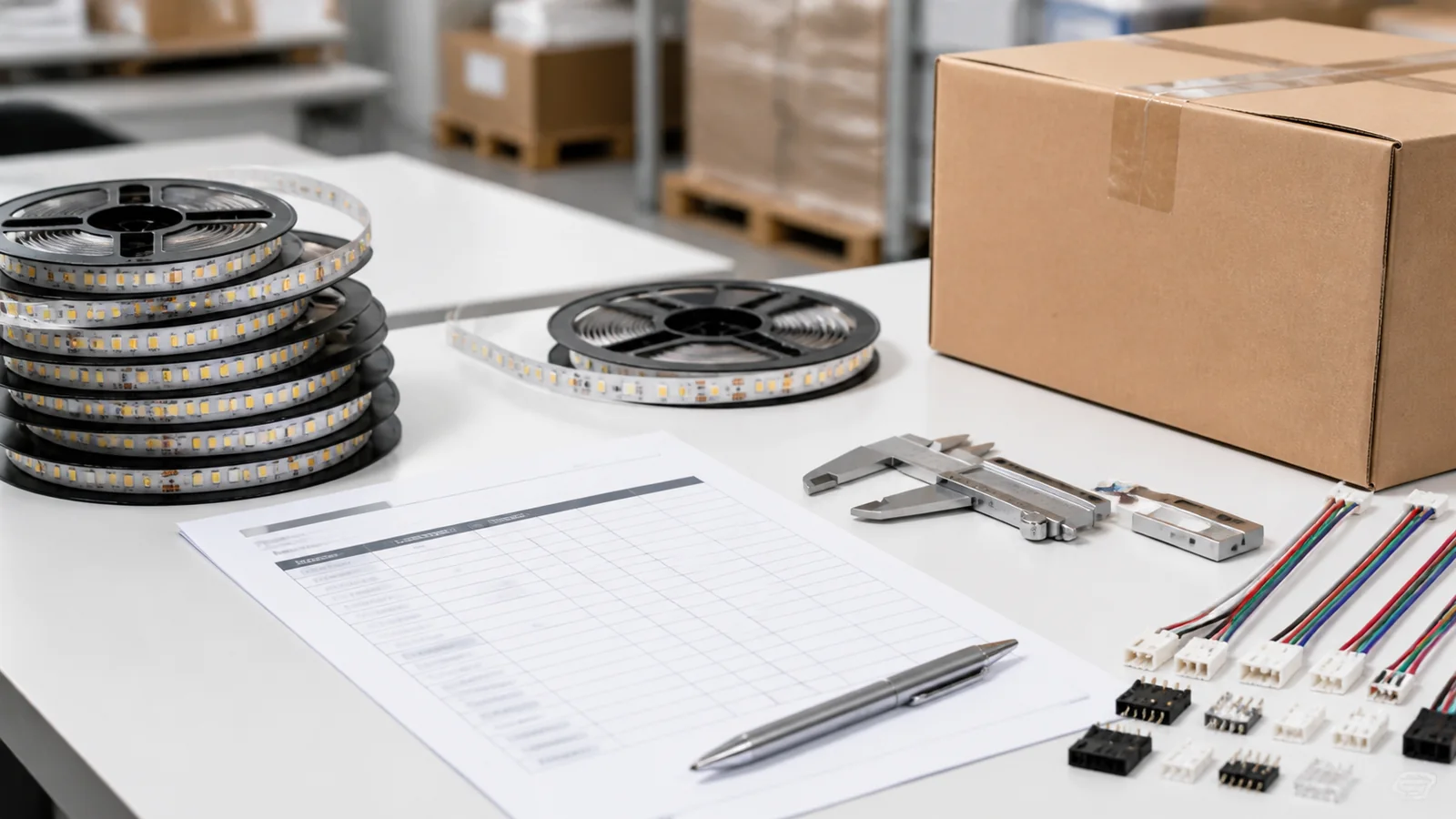
Calculate LED strip from individual finished runs
Measure every continuous illuminated section on the latest coordinated drawing. Keep each section as a separate line in the takeoff. Round the required length to a valid cut unit for the selected strip, add the specified leads and terminations, then group identical sections by model and color temperature. Convert the resulting total into reels only after the cut schedule is complete.
Do not estimate a project by multiplying room area or perimeter alone. Doors, cabinet breaks, corners, access panels, dark gaps, driver zones and feed points change the usable strip lengths. A total-meter figure also hides whether the chosen reel lengths can be cut efficiently.
A controlled takeoff has three totals:
- finished strip required in the installation;
- production or site-cut allowance created by cut intervals and reel optimization;
- separately approved maintenance spare.
Keeping these totals separate prevents an unexplained percentage from covering design changes or measurement errors.
Start with coordinated and scaled information
Collect the reflected ceiling plans, joinery elevations, lighting details and room schedule. Use the latest revision and record its date on the takeoff. For imported PDFs, verify the drawing scale against a known dimension before measuring.
Mark these items before tracing any LED route:
- start and end of each illuminated line;
- intentional dark gaps and fixture breaks;
- inside and outside corners;
- profile joints and maximum available profile length;
- cable exits and feed locations;
- driver and controller zones;
- access panels and service points;
- indoor, protected and exposed areas;
- product changes in width, CCT, color or control type.
The lighting drawing may show one continuous graphic line while the electrical design divides it into several powered branches. Record the physical length and electrical branches separately. The LED strip wiring guide explains how branch design affects feeds and cables.
When dimensions are missing, add them to an information request. A scaled estimate can support budgeting, but it should be labeled as an estimate and replaced when approved dimensions arrive.
Create one row for every finished section
Use a schedule with fields such as:
| Field | Purpose |
|---|---|
| Area and run ID | Connects the material to the drawing and installation location |
| Model or strip type | Separates different voltage, width, output and control requirements |
| Drawing length | Records the measured illuminated path |
| Required finished length | Includes approved offsets and dark sections |
| Cut-unit length | Sets the valid manufacturing increment |
| Ordered cut length | Shows the rounded manufacturable length |
| Quantity | Counts repeated cabinets, shelves or rooms |
| Lead and cable exit | Defines assembly orientation |
| Reel or batch group | Supports cutting and packing |
Repeated joinery should still have a run ID for each installed location. A hotel may use the same headboard detail many times, but left-hand and right-hand cable exits can create two assemblies. List them separately even if the illuminated length matches.
For curves, measure along the strip centerline. Do not measure a straight chord across the curve. Confirm the bend direction and minimum radius for neon flex or flexible profile before approving the measured path.
Profiles deserve their own quantity schedule. Strip can sometimes be supplied in one continuous electrical length while aluminum profiles arrive in shorter rigid sections. Profile joints, diffuser lengths and end caps will not necessarily equal the strip reel count.
Round each section to a valid cutting point
Flexible LED strip can only be cut at its marked cutting positions unless the exact product is designed for another method. The cutting unit depends on the model, voltage and circuit arrangement.
Use this planning formula for a section that must not be shorter than the drawing:
Ordered units = round up (required length ÷ cut-unit length)
Ordered cut length = ordered units × cut-unit length
Suppose a cabinet needs 1,186mm of illuminated strip and the selected model cuts every 50mm. Rounding up produces 24 units, or 1,200mm. The cabinet detail must accept the extra 14mm. If it cannot, adjust the physical starting point, choose another cut interval or change the lighting detail before ordering.
LEDVANCE’s official page for one 24V LED strip model lists a smallest cutting unit of 55.56mm. That number belongs to the stated product and must not be transferred to another strip. Signify’s LED strip design guide also shows model-specific maximum lengths that change with product power and connection method.
The usable finished length should be approved with its profile and diffuser. A strip that fits mathematically can still collide with an end cap, connector or cable bend.
Optimize reels after the cut schedule is fixed
Add all ordered cut lengths for the same model, voltage, CCT, protection construction and batch group. Do not combine unlike products merely because they share a PCB width.
Next, arrange finished sections across the available reel length. This is a cutting-stock problem. A 5m reel can produce five 1m sections, but it cannot produce three 1.8m sections because the total is 5.4m. Short leftovers may be useful only if they contain enough valid cut units and remain identifiable.
Include these sources of material demand:
- cut-unit rounding on each section;
- trimming or preparation required by the approved connection method;
- samples and mock-ups that will not be reused;
- destructive or retained inspection samples;
- replacement stock approved by the buyer;
- minimum full-reel purchasing rules where applicable.
Keep maintenance spare as a named line, not buried inside every run. Choose it from the replacement strategy. A hotel with repeated room modules may need complete labeled room sets. A one-off facade may need spare lengths matching the same production batch. Our spare-quantity guide covers that decision.
For factory pre-cut assemblies, send the cutting plan to the supplier and ask it to report expected reel utilization and residual material before production. Confirm whether unused balance belongs to the buyer, remains at the factory or is included in the quoted loss allowance.
Worked takeoff example
A retail project has the following 24V white-strip runs:
| Location | Required length | Cut unit | Rounded cut length | Quantity | Total |
|---|---|---|---|---|---|
| Wall shelves | 1,186mm | 50mm | 1,200mm | 12 | 14.4m |
| Display plinths | 2,030mm | 50mm | 2,050mm | 6 | 12.3m |
| Cash desk | 3,420mm | 50mm | 3,450mm | 1 | 3.45m |
The finished rounded total is 30.15m. That is not automatically seven 5m reels. The cutter must place the individual sections across reels, account for connection preparation and confirm whether any residual lengths are usable. Maintenance spare is then added as its own approved quantity.
The electrical schedule may divide the 3.45m cash-desk line into more than one feed, but the strip quantity remains based on the finished physical path. The takeoff and wiring schedule should reference the same run ID so neither discipline silently changes the other.
Send a controlled schedule with the RFQ
Before requesting a final quotation, check that the schedule states:
- drawing revision and measurement unit;
- run ID and installation location;
- strip model, voltage, power and CCT or color;
- finished length and quantity of every section;
- confirmed cut interval and rounding rule;
- lead length, wire colors and cable-exit direction;
- connector or soldered-joint requirement;
- protection and end-treatment requirement;
- feed point and controller zone reference;
- reel length and requested cutting plan;
- sample, mock-up and inspection quantities;
- maintenance spare as a separate line;
- packing labels by room, area or circuit.
After design approval, freeze the schedule and manage later changes by revision. Do not replace it with one grand total. For a wholesale quotation, submit the drawing and takeoff through the quote form. Standard MOQ is 500m, and the final model, cut plan, assembly details and packing must be confirmed before production.
Catalog & Sourcing Note
This article is prepared from our current product catalog and B2B specification workflow. Electrical, waterproofing and installation requirements vary by model and market, so confirm the final specification and approved sample before ordering.
Discuss Your Specification