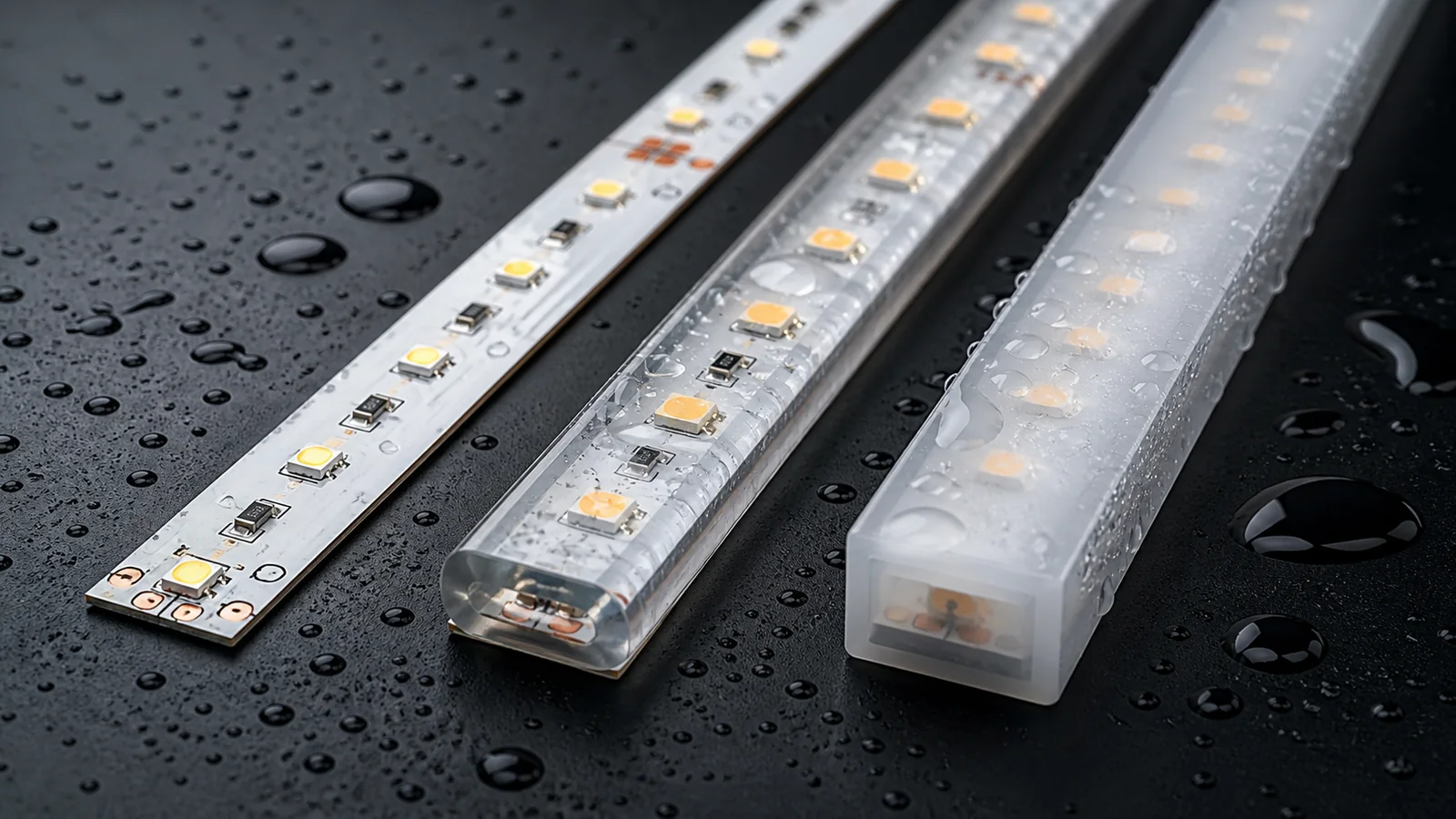
An IP rating describes protection against solid objects and water under defined test conditions. It does not guarantee that every cut, connector, end cap, cable entry, power supply, and installation detail has the same protection.
For buyers, the useful rule is: IP20 is for dry indoor areas, IP65 is for protected locations exposed to dust or water jets, and IP68 is for higher water protection when the exact model and test conditions match the application. Always review the complete installed system.
What the IP Code Means
“IP” stands for ingress protection. The first digit describes protection against solid objects; the second describes water protection. A higher number is not automatically a better buying decision because stronger encapsulation can change dimensions, bending, heat transfer, cutting, connection, light output, and price.
The rating should be supported by evidence that identifies the relevant product and construction. A report for a different sealing process does not prove the quoted model has the same performance.
IP20, IP65 and IP68
| Rating | Practical starting point | Typical applications | Main buyer checks |
|---|---|---|---|
| IP20 | Open indoor strip for dry locations | Shelves, coves, cabinets, profiles | Dust, cleaning method, profile and diffuser |
| IP65 | Protected strip for dust and water exposure | Kitchens, bathrooms outside restricted zones, sheltered outdoor accents | Coating/extrusion method, cut sealing, connectors |
| IP68 | Higher-protection construction | Demanding wet environments, subject to model limits | Test conditions, immersion limits, cable entry, heat and chemicals |
IP20
IP20 products are usually the most compact and easiest to cut, solder, and install inside aluminum profiles. They are appropriate where water exposure is not expected. The profile and diffuser can provide physical protection, but they do not automatically turn the strip into an IP-rated system.
IP65
IP65 products may use a surface coating, sleeve, or silicone extrusion depending on the model. These constructions are not interchangeable. Ask how the strip is sealed after cutting and whether matching connectors or end caps are available.
IP68
IP68 indicates a higher level of water protection, but the test depth and duration are agreed by the manufacturer and test method. Do not assume unlimited underwater use. Confirm whether the intended application involves continuous immersion, chlorinated water, salt water, cleaning chemicals, high temperature, or mechanical stress.
Our current catalog includes IP65 and IP68 options; availability varies by LED package, voltage, PCB width, and power.
The Complete System Matters
Most site failures occur at interfaces rather than in the middle of a sealed reel. Pay close attention to:
- cut ends and end caps;
- solder joints and quick connectors;
- cable entries and extension cables;
- the driver or rectifier enclosure;
- drainage and mounting orientation;
- bending radius and mechanical tension;
- UV, salt, chemicals, and cleaning products;
- heat dissipation and ambient temperature.
For long outdoor lines, divide the project into serviceable sections. This makes power injection, replacement, inspection, and water management easier. Avoid placing a connection at the lowest point where water can collect.
Supplier Checklist
Before approving a bulk order, request the exact model code, construction drawing, dimensions, cut interval, rated power, voltage, roll length, accessory list, and model-matched waterproof documentation. Ask how samples and production will be sealed after cutting.
Your purchase specification should define:
- required IP rating and actual environment;
- strip and connection method;
- cable length and exit direction;
- end-cap and adhesive/sealant process;
- operating temperature and daily hours;
- inspection or test method agreed for production;
- packaging that prevents bending and seal damage.
Approve a finished sample that includes the same cable, connector, end seal, and accessories planned for production—not only an uncut reel.
FAQ
Is IP68 always better than IP65?
No. IP68 may be necessary for demanding wet environments, but it can cost more and change size, flexibility, heat transfer, and connection work. IP65 may be more practical for protected outdoor or splash-exposed zones.
Can an IP65 strip be installed outdoors?
Potentially, if exposure, drainage, connections, UV, temperature, and local electrical requirements are suitable. The whole system must be reviewed, not just the strip label.
Does cutting invalidate the waterproof rating?
Cutting opens the protected construction. The cut end must be resealed with the specified method and allowed to cure where applicable. Ask the supplier for the approved process and accessories.
Can IP68 strip be used in a swimming pool?
Do not assume so from the rating alone. Pool use adds electrical zoning, chemicals, continuous immersion, cable-entry, maintenance, and local-code requirements. Obtain written model suitability and use qualified system design and installation.
Specifications and document scope vary by model. Confirm the quotation, sample, and installation plan before ordering.
Catalog & Sourcing Note
This article is prepared from our current product catalog and B2B specification workflow. Electrical, waterproofing and installation requirements vary by model and market, so confirm the final specification and approved sample before ordering.
Discuss Your Specification