The short answer
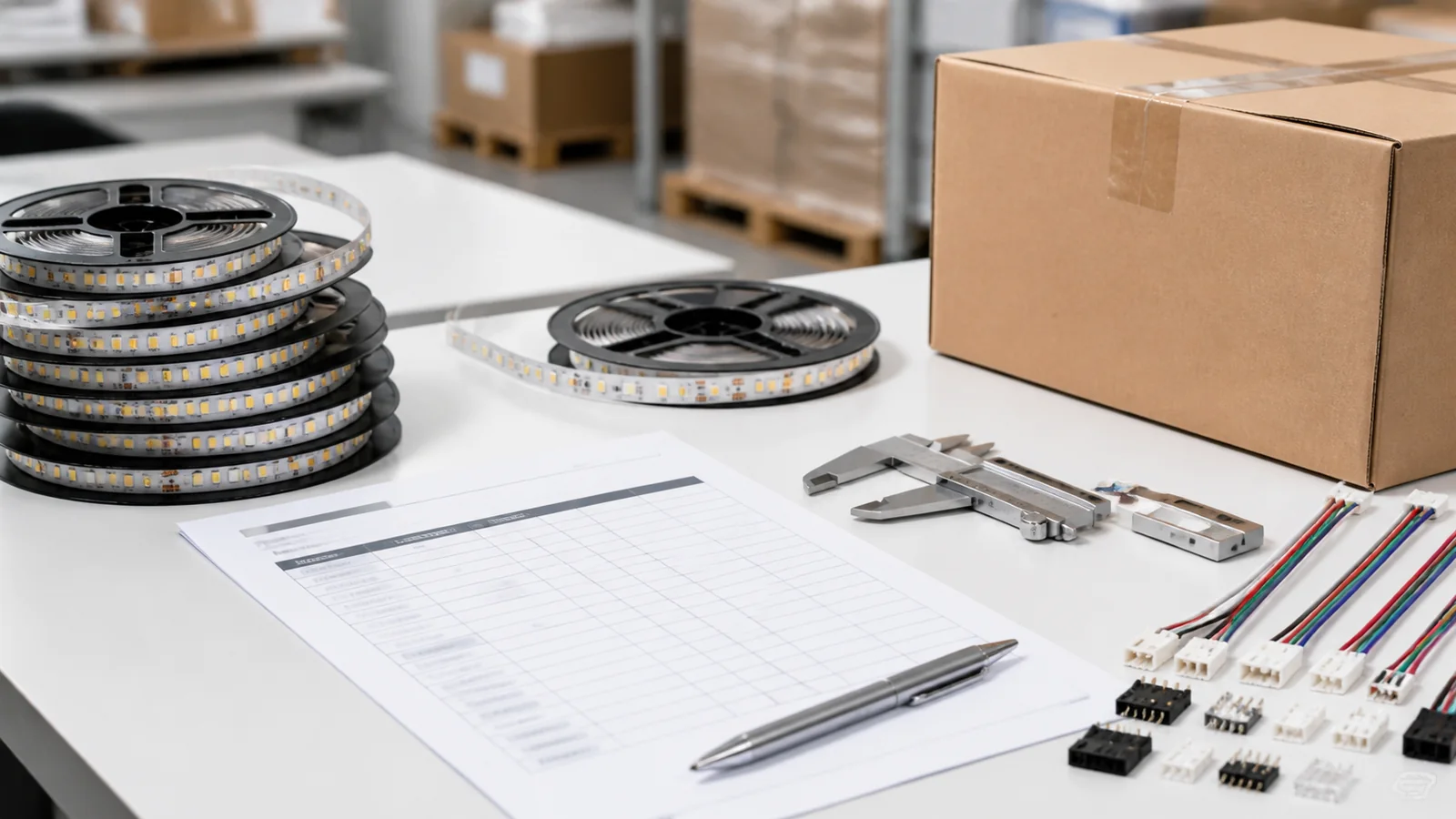
If several LED strip reels will be visible in the same room, cove, shelf run or façade, do not specify only “3000 K” and “CRI 90.” Add a target chromaticity and tolerance, define whether all reels must come from one controlled production lot, approve a powered sample, and state how production will be measured.
SDCM is common purchasing shorthand, but it is not a complete specification by itself. Ask what center point, chromaticity region, measurement method and production condition the SDCM claim refers to. For demanding projects, record CIE 1976 u′,v′ coordinates or an agreed chromaticity region along with the nominal CCT.
The goal is not to buy the smallest number on a data sheet. It is to prevent a visible jump between adjacent reels and to make a later replacement or repeat order predictable.
Why the same CCT can still look different
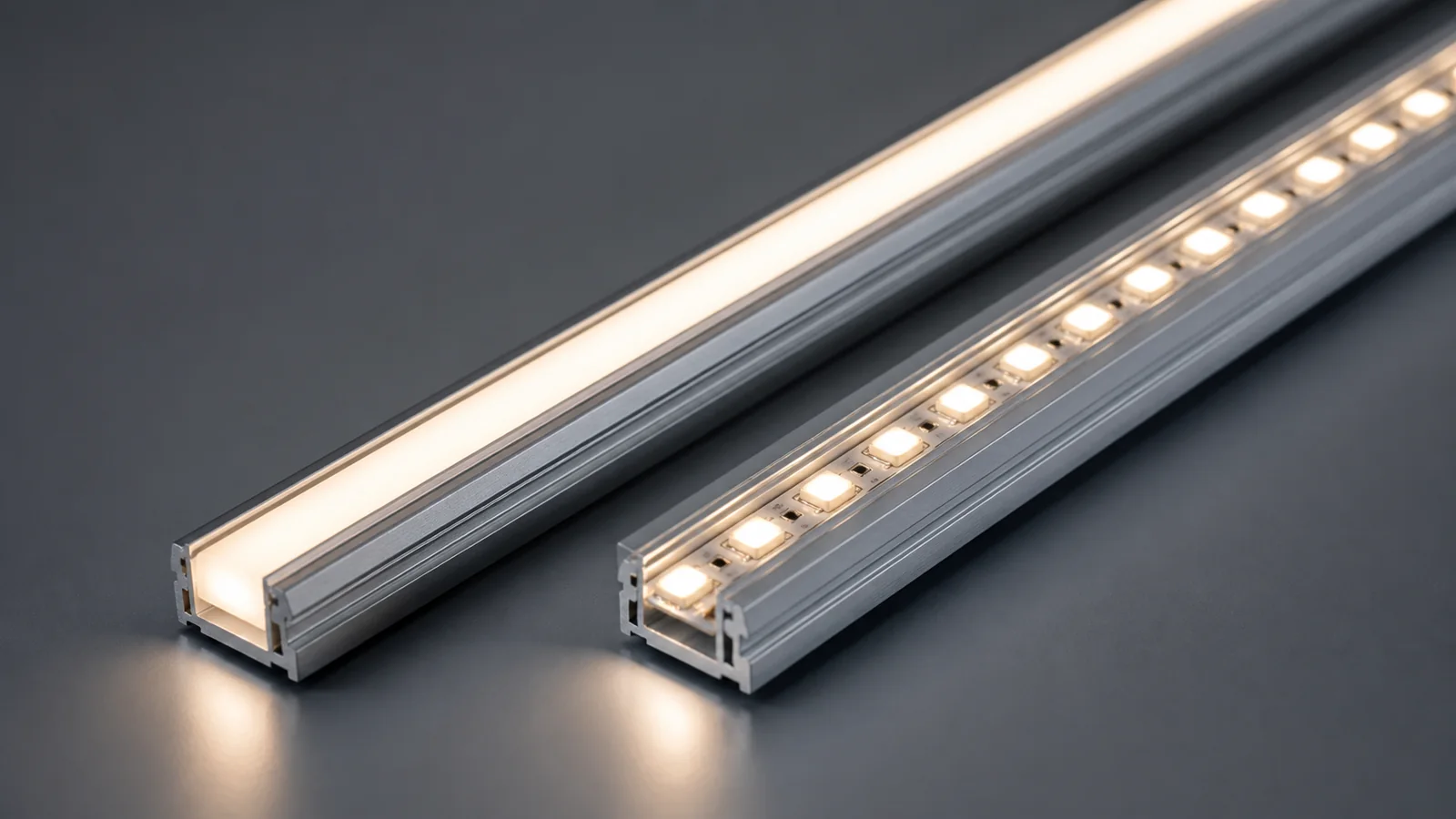
Correlated color temperature describes where a white light source sits in relation to the Planckian locus. It does not fully describe its chromaticity. Two sources can both be reported as 3000 K while one appears slightly greenish and the other slightly pinkish.
Duv helps describe whether the chromaticity lies above or below the Planckian locus. Chromaticity coordinates locate the measured color more completely. A procurement file that keeps only nominal CCT loses information needed to compare batches.
CRI is a different property. It describes aspects of how object colors appear under a source compared with a reference. It does not tell you that two reels have the same chromaticity. A high-CRI reel can still look visibly different from another high-CRI reel installed beside it.
Power conditions also matter. Voltage drop can change output and may affect the appearance along a long run. Thermal conditions, diffuser material, reflected surfaces and adjacent finishes can make a small source difference easier to see. Before blaming LED binning, verify the power-feed design using the LED strip voltage-drop calculation guide.
What SDCM means—and what it leaves out
SDCM means standard deviation of color matching. In lighting sales, phrases such as “3-step” or “3 SDCM” are often used to describe a chromaticity tolerance around a target. Smaller regions can indicate tighter initial color grouping, but the number is meaningful only when the reference region and method are defined.
The International Commission on Illumination addresses an important limitation in CIE TN 001:2014: MacAdam ellipses differ in size and shape across the chromaticity diagram, so one SDCM is not a constant distance. CIE recommends u′v′ circles or suitable quadrangles for specifying tolerances near the Planckian locus and recommends chromaticity difference Δu′,v′ for broader use. The note discourages using SDCM or “just noticeable difference” as universal units.
This does not make an SDCM claim useless. It means the buyer should ask four follow-up questions:
- What is the target center point or nominal chromaticity region?
- Which color space and calculation are used?
- Is the claim for individual LEDs, a finished strip, or measured production reels?
- Does it cover only initial color, or also angular uniformity and change over time?
Do not convert “3 SDCM” into a promise that no person will see a difference. Visibility depends on the direction of the color shift, viewing conditions, distance, surfaces, diffuser and whether the sources are adjacent.
Binning is a production tool, not the finished acceptance rule
LED manufacturers sort devices into bins for characteristics such as chromaticity and flux. A strip assembler may then control which bins enter one order. The bin code is valuable for traceability, but it does not replace measurement of the finished strip.
Phosphor, encapsulation, operating current, PCB temperature and production variation can influence the assembled result. For COB strip, the continuous phosphor layer and manufacturing process introduce their own controls. For SMD strip, packaged-LED bin selection is more directly visible, but the finished reel still needs verification.
Ask for both: the component-bin control used for the order and the acceptance data from finished production.
Separate three different consistency problems
1. Variation along one reel
A single powered reel may show a gradual or abrupt color change. Possible causes include mixed components, local temperature differences, current variation, material inconsistency or a splice between production sections.
Inspect more than the first cut segment. Power a representative length using the approved voltage and feed arrangement. View it through the intended diffuser when the installation uses one.
2. Reel-to-reel variation in one order
This is the usual source of visible joins in a long cove or repeated shelf system. The procurement response is straightforward: define one lot, require controlled bin usage, identify every reel by batch, and sample across cartons rather than taking several reels from the top layer.
Where adjacent runs must match, tell the supplier how the reels will be grouped at installation. The factory can then keep those reels within the same controlled batch and label the cartons accordingly.
3. Repeat-order or replacement variation
An approved sample from last year does not guarantee that a new production lot will be visually identical. Component bins and materials change, and the original sample may have aged.
For repeat programs, retain measured coordinates and production records, not only a physical sample. State the allowed shift from the approved target and require notification when the original bin or material is unavailable. For critical sites, purchase spare reels from the original lot and store them under suitable conditions.
How to write a usable color-consistency specification
Begin with the installation risk. A concealed strip illuminating separate hotel rooms is less sensitive to reel-to-reel comparison than multiple exposed lines on one retail wall. Tighten controls where sources are visible together or illuminate the same neutral surface.
Then write the following items into the RFQ and approved data sheet:
| Item | What to define |
|---|---|
| Product | Exact model, voltage, power, PCB width, IP construction and diffuser/profile |
| Target color | Nominal CCT plus target chromaticity coordinates or agreed region |
| Tolerance | SDCM region with method, or u′v′/Δu′,v′ limit agreed for the project |
| Lot rule | Whether all reels must use one controlled component bin and production batch |
| Measurement | Instrument type, stabilization time, ambient condition, supply voltage and test point |
| Sampling | Reels per lot, locations per reel and carton distribution |
| Records | Individual readings, batch code, component bin and pass/fail result |
| Repeat orders | Reference target, allowed shift and substitution-notification rule |
Avoid copying a tolerance from another project without checking measurement uncertainty. A limit that is close to the instrument’s uncertainty can produce arguments rather than control. The supplier and buyer should agree how uncertainty and rounding are handled before measurements are compared.
Do not use a phone camera as the acceptance instrument
A photograph is useful for showing where a mismatch appears, but automatic white balance, exposure, image processing and screen settings alter the result. Use visual assessment as a practical screen and a suitable calibrated color-measurement instrument for decisions that depend on coordinates.
The instrument, geometry and test conditions should stay consistent between sample approval, production and receiving. A reading taken immediately after switch-on should not be compared with one taken after the strip has warmed up unless the procedure allows it.
A sample and inspection plan that catches real problems
Before production
Approve a sample at the intended voltage, power setting, profile and diffuser. Record its model, batch, measured chromaticity, CCT, Duv where used, power and test conditions. If the application involves dimming, check the relevant operating levels because driver or controller behavior can affect the result.
Mark the sample as a visual reference, but keep the numerical record. Physical samples can age, become contaminated or be viewed under different conditions.
During production
Require a controlled component-bin issue record and finished-strip measurements across the lot. The sampling plan should spread readings across the beginning, middle and end of production and across packing groups. If reels will be installed side by side, the measurement plan should reflect that risk.
Before shipment
During the pre-shipment inspection:
- select cartons from different pallet positions;
- verify reel and carton batch labels;
- power representative full lengths or agreed sample lengths;
- compare adjacent reels on the same supply and test setup;
- measure at the agreed locations after the specified stabilization period;
- record coordinates, not only “warm white—pass”;
- hold mixed or untraceable batches until the supplier explains the segregation.
Waterproof samples should be tested in the supplied construction. Removing an encapsulated strip from its silicone body to make measurement easier changes the optical system and may not represent the installed product.
Color-consistency questions for your RFQ
Send these questions with the model and application details:
- What target CCT and chromaticity region will be used for this order?
- If SDCM is quoted, what center point, color space and method define it?
- Which LED or COB material bin will be allocated?
- Will all reels in the order come from one controlled production batch?
- How is the finished strip measured, and under what voltage and stabilization conditions?
- How many reels and points per reel are checked?
- Will individual readings and batch codes be supplied with the inspection record?
- How will cartons be labelled so installers can keep matching reels together?
- What happens if a repeat order cannot use the original bin or target region?
- Can the supplier provide extra reels from the same lot for future repair?
For product selection, compare the COB LED strip range and SMD LED strip range by voltage, power, CRI, construction and application before setting the color tolerance. A precise chromaticity requirement cannot compensate for the wrong electrical or mechanical product.
The useful result is a specification that production and receiving teams can measure. “Same color as last time” is a complaint waiting to happen; a target, tolerance, batch record and agreed test method give both buyer and supplier something they can verify.
Catalog & Sourcing Note
This article is prepared from our current product catalog and B2B specification workflow. Electrical, waterproofing and installation requirements vary by model and market, so confirm the final specification and approved sample before ordering.
Discuss Your Specification