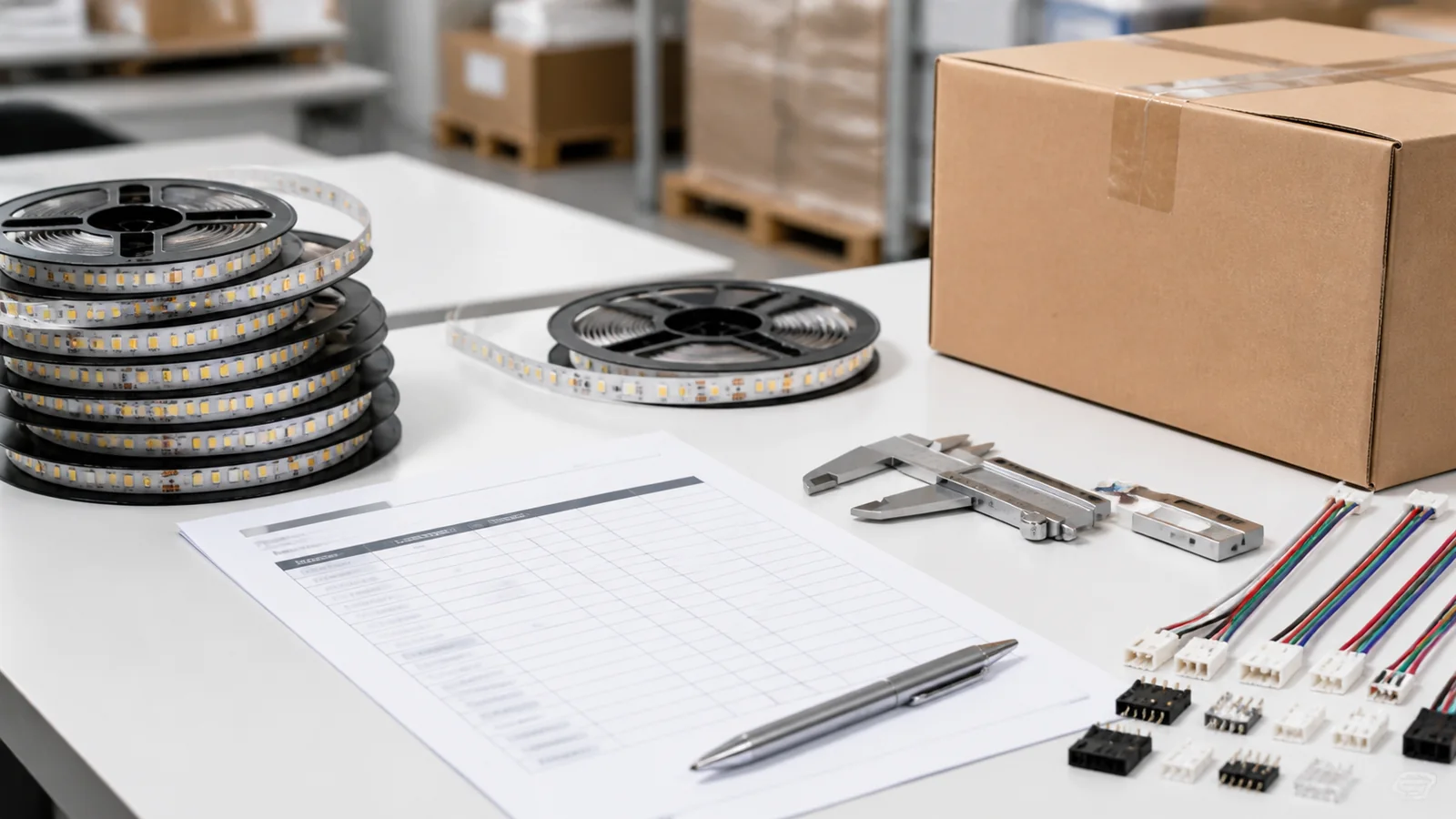
Read the datasheet as one system specification
Begin with the exact model code and revision date. Check rated voltage, watts per meter, current, reel length and maximum powered length together. Then review light output, CCT, CRI, color consistency, PCB width, cutting unit, protection construction, temperature limits and control method. Every number should apply to the same model and test condition.
A datasheet supports shortlisting. It does not prove that a delivered batch matches every value. Resolve missing units and ambiguous conditions before quotation, approve a production-representative sample, and put the agreed acceptance fields on the purchase specification.
Avoid comparing two products from headline values copied into separate sales tables. One supplier may state typical lumens at a specified temperature, while another gives a nominal family value without the same test condition. The numbers only become comparable after their scope is clear.
Confirm the document belongs to the quoted model
Match the model code across the quotation, datasheet, sample label and final packing. Similar family names may cover several voltages, CCTs, PCB widths or protection versions.
Record:
- complete orderable model code;
- datasheet revision or issue date;
- rated voltage and current type;
- CCT or color option;
- protection construction;
- reel length or supplied unit;
- any suffix that changes CRI, output or control;
- stated tolerances and test conditions.
If the quotation says “same as datasheet,” attach the exact file to the approved order. A web page that changes later should not become the only record of what was agreed.
The LEDVANCE page for LS P-1000/930/5 shows why the full code matters. The published page identifies 24V DC, 8.6W/m, a 55.56mm cutting unit, output per meter, CCT, CRI, color-consistency data and physical dimensions for that model. Those values cannot be assumed for another member of the same product family.
Read electrical data by powered section
Check these fields:
| Datasheet field | Buyer question |
|---|---|
| Rated voltage | Does it match the supply and controller? |
| Input-voltage range | How much variation does the exact model permit? |
| Watts per meter | Is the value nominal, typical or a maximum? |
| Power tolerance | What variation is allowed between stated and measured power? |
| Current per meter or reel | Can the cable, connector and controller carry it? |
| Maximum powered length | Does it apply to single-end feed, double-end feed or another arrangement? |
| Dimming method | Which supply and controller interface is required? |
Calculate branch load from watts per meter and the actual powered length. Do not size the system from total project meters alone. The power-supply and voltage-drop guide explains the calculation.
Maximum powered length is model-specific. Signify’s CorePro and MASTER LEDstrip design guide lists different length limits for products with different watts per meter and connection arrangements. A maximum from one row should not be transferred to a different strip.
For tunable-white, RGB, RGBW and addressable products, determine whether the stated power is total maximum power or a value under a particular channel condition. Confirm channel current and controller loading in writing.
Separate output, efficacy and color quality
Luminous flux per meter states how much light the strip emits under the stated test condition. Luminous efficacy divides lumens by watts. Neither value describes color rendering, color consistency or how the diffuser changes the installed result.
Review:
- lumens per meter and its tolerance;
- watts per meter used for the efficacy calculation;
- CCT and permitted CCT range;
- CRI value and whether a higher R9 or another color metric is required;
- SDCM or binning statement where color consistency matters;
- beam angle and measurement convention;
- test temperature and whether output is initial or maintained;
- dimming condition used for the stated value.
Two strips can have the same nominal CCT and still look different side by side. Approve adjacent areas from the same accepted production grouping where visible consistency matters. The SDCM and binning guide explains the purchasing controls.
Installed output changes with the profile, diffuser, cavity and surface reflectance. Test the strip in the actual assembly if the project depends on a minimum illuminated level or dot-free appearance.
Mechanical fields decide whether the strip fits
At minimum, confirm:
- PCB width and strip thickness;
- LED or light-emitting construction;
- LED density per meter;
- cutting-unit length;
- pad layout and number of channels;
- reel length and lead arrangement;
- minimum bend limitation;
- connector clearance;
- adhesive or mounting method;
- profile internal width and diffuser clearance.
LED density does not determine brightness by itself. It affects visual spacing, cut-unit design and power distribution, while output depends on the complete electrical and thermal design.
Use the cutting unit to check every finished section. A specification that calls for a 1,175mm strip cannot be fulfilled exactly by a model that only cuts at 50mm intervals. The quantity-takeoff guide shows how to round and schedule those lengths.
Measure the sample with a caliper and place it inside the proposed profile. A connector may be wider or taller than the PCB and prevent the diffuser from closing even when the bare strip fits.
Define the installed environment
Do not reduce environmental selection to one IP number. Check the construction, operating temperature, storage temperature, mounting surface, UV exposure, chemicals, condensation, drainage and end treatment.
The stated protection applies to the described product configuration. Cutting, soldering, connectors, cable entries and end caps can change the finished assembly. Ask for the joint and termination method required for the selected model.
Distinguish ambient temperature from the temperature measured at the product’s stated reference point. A strip mounted in a closed display, ceiling recess or sun-heated facade may operate above room temperature. Power equipment also has its own temperature and ventilation limits.
If particular tests or documents are required for the project, name them before quotation and confirm what exists for the exact model. Do not rely on an unrelated family file or logo.
Turn the datasheet into sample checks
Create an approval table with three columns: specified value, supplier statement and measured or inspected result. Include only fields that can be checked with an agreed method.
A practical sample review may include:
- model and label traceability;
- PCB width, reel length and cutting unit;
- rated-voltage power-on check;
- input power under an agreed stabilized condition;
- start and far-end voltage on the representative run;
- CCT and color comparison against the approved reference;
- profile and connector fit;
- dimming or controller operation;
- completed joint and termination inspection;
- packaging and reel labels.
Lumens, color data, temperature and protection tests require defined equipment and conditions. Agree on the method, sample size and acceptance limit before production. A handheld reading taken under unknown conditions should not be presented as equivalent to a controlled test.
Fields to lock before a bulk order
Add these items to the purchase specification:
- exact model code and accepted datasheet revision;
- voltage, power per meter and tolerance;
- CCT or color, CRI and agreed consistency requirement;
- output field and its test condition where required;
- PCB width, cutting unit and reel length;
- maximum powered length and feed arrangement;
- controller and dimming compatibility;
- environmental construction and joint method;
- wire, lead and connector requirements;
- sample approval reference;
- incoming and pre-shipment inspection points;
- labeling and packing requirements;
- method for recording approved deviations.
Mark unanswered fields as pending. Do not fill them with a generic family value. LEDStripStar’s product pages list the currently available catalog fields, but final configuration and order requirements must be confirmed before quotation and production. Submit the required model, quantity and application through the quote form. Standard wholesale MOQ is 500m.
Catalog & Sourcing Note
This article is prepared from our current product catalog and B2B specification workflow. Electrical, waterproofing and installation requirements vary by model and market, so confirm the final specification and approved sample before ordering.
Discuss Your Specification