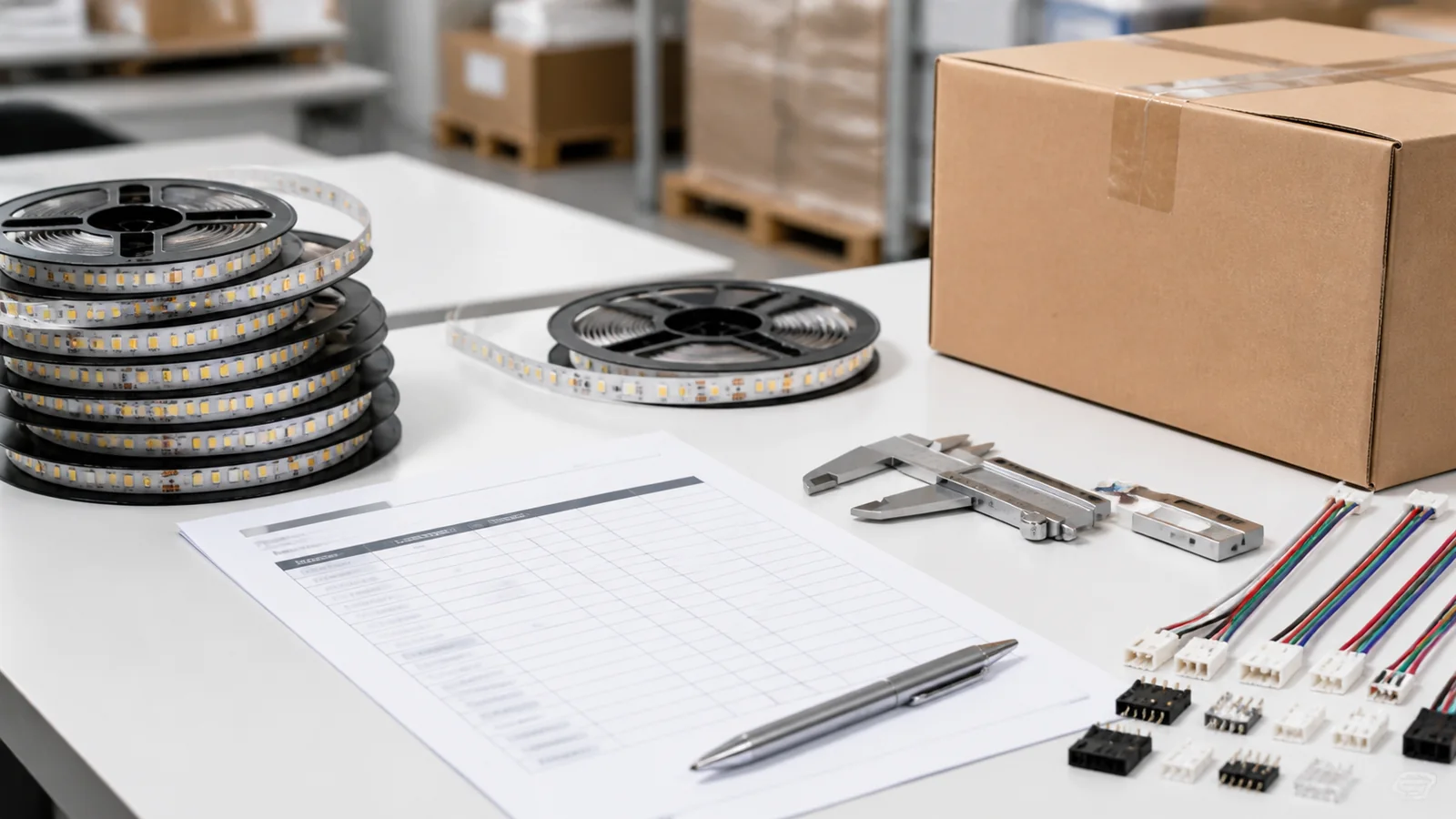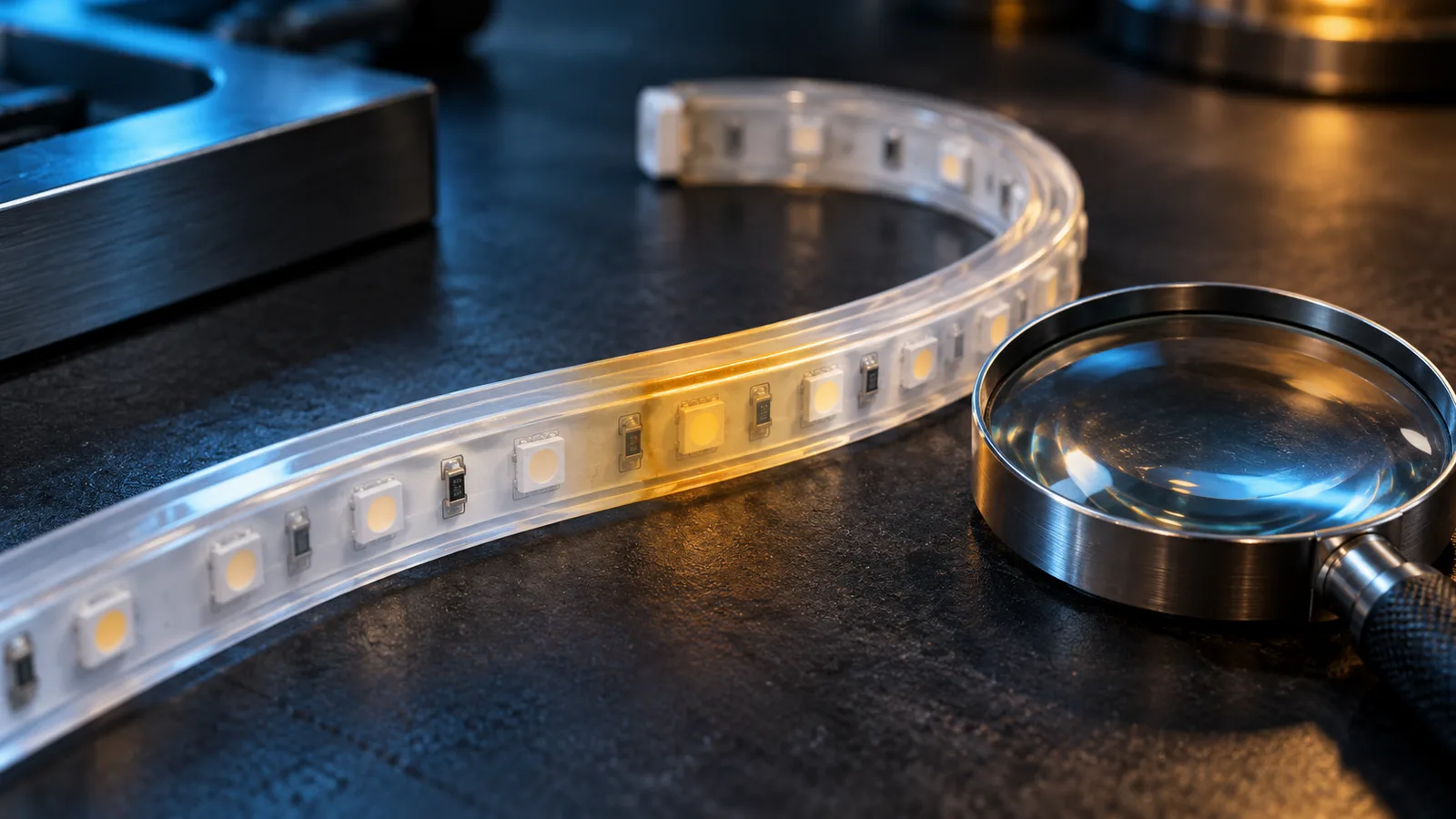
A waterproof LED strip may show discoloration because a protective material has aged or because nearby materials have reacted with its components. First establish what changed: the outer jacket, the LED package, the diffuser, or the emitted light. A yellow appearance by itself cannot identify the cause. The yellow phosphor surface visible on many new white COB strips is part of their construction and does not, by itself, indicate deterioration.
Before placing a replacement order, record the original appearance and identify the changed layer. New tape will leave a discolored diffuser in place, while a different white color temperature will leave a damaged jacket unresolved.
Find the layer that changed
Have qualified personnel isolate the power before inspecting the assembly. Compare it with an unused sample of the same construction and batch, if one is available. Use consistent room lighting and camera settings. A photograph made under different white balance is poor evidence of a color change.
Many white COB tapes have a continuous phosphor-containing surface that looks yellow while unpowered. Check the original sample or product photo before treating that surface as a fault. OSRAM’s chemical-compatibility application note explains phosphor conversion and distinguishes package materials from their degradation mechanisms. Its examples concern LED packages; they do not diagnose a particular strip’s outer jacket.
| Observation | Next check | Limit of the observation |
|---|---|---|
| A new COB strip has a yellow surface while unpowered | Compare with the specified phosphor construction | Yellow phosphor alone does not establish a fault |
| The transparent outer layer has changed appearance | Compare with a retained sample and record sunlight, heat and cleaning exposure | Appearance does not identify the polymer or failure mechanism |
| The channel cover is discolored but the strip looks unchanged | Inspect a safely removable cover separately | Replacing only the tape may leave the optical problem |
| Individual LED packages have darkened | Ask the supplier to review package condition and surrounding materials | A photo cannot distinguish every chemical or thermal mechanism |
| The light looks warmer but the assembly looks unchanged when off | Review supply conditions, dimming, optics and measured color | Camera auto white balance cannot establish a CCT change |
Silicone construction still needs a defined exposure limit
OSRAM describes thermal oxidation and chemical contamination as possible mechanisms for package discoloration. Silicone materials can also degrade under extensive thermal stress, according to the note. Review the material and operating conditions before diagnosing a fault from the word silicone alone.
Dow’s optical-materials overview describes improved UV and heat resistance for its optical silicone technologies and photothermal stability for secondary encapsulants. Those are material-family descriptions. A supplier still needs to identify the actual grade, construction and applicable conditions before you rely on those properties for a finished strip. Neither source establishes a yellowing-free lifetime for LEDStripStar tape.
Check the original order for the strip reference and protective-material description. Record the channel cover, end seal and any adhesive or sealant added during installation. Include the cleaners used and note whether the change followed cleaning or building work. Nearby material can affect the LEDs even when it is outside the tape.
The catalog’s COB-8MM-320LED (RA80) silicone-IP68 family and 2835-8MM-120LED (RA80) silicone-IP68 family both list silicone construction. Those entries are starting points for selection. They do not establish a specific outdoor aging result, chemical compatibility or resistance to every cleaning product.
Keep the investigation safe and reproducible
If the assembly has damaged insulation, signs of overheating or moisture at an electrical connection, keep it isolated and have it assessed before further operation. Avoid scraping the coating, peeling the jacket or applying solvents as a diagnostic shortcut. These actions change the sample and may damage its protection.
Mark affected locations on a drawing and note whether the change is uniform, concentrated at joints or limited to exposed sections. Sunlight or a hot recess may warrant investigation, but a location pattern alone does not prove the cause. Keep an affected sample and an unused reference when available, together with their labels and installation history.
Where powered comparison is appropriate, qualified personnel should follow the equipment instructions in a suitable dry setup. Compare the same supply and control conditions. Use measured color information if a color shift is part of the complaint; visual impressions and phone photographs cannot establish its size. The datasheet guide helps identify which conditions need to match.
Keep the sample intact for review. Running it hotter, exposing it to solvents or opening a protected assembly is not a suitable recovery method. Package experiments in a manufacturer’s application note are not field-repair instructions. If the tape needs replacement, retain the evidence before disposal and resolve any exposure or installation issue before ordering the same construction again.
Include these items in the supplier review:
- Product reference, batch label, order date and installation location.
- Matched unpowered photographs, plus the original appearance if recorded.
- The affected layer and the extent of discoloration along the run.
- Supply and dimming arrangement, mounting detail and operating schedule.
- Sunlight, ambient conditions, cleaners and materials added near the strip.
- The project’s required replacement appearance and environmental limits.
For an unresolved outdoor exposure, also review the coastal-lighting selection checklist. An ingress rating alone leaves several aging and corrosion questions open.
Send the construction and installation detail through the quotation form before purchasing a replacement. Standard MOQ is 500 meters and custom MOQ is 2,000 meters. Ordinary warranty is 2 years; confirm the applicable terms for the order rather than treating the warranty period as evidence of resistance to yellowing.
Catalog & Sourcing Note
This article is prepared from our current product catalog and B2B specification workflow. Electrical, waterproofing and installation requirements vary by model and market, so confirm the final specification and approved sample before ordering.
Discuss Your Specification